June 17, 2026
Where the Gospel Takes Root
How Alliance workers and Mongolian
leaders are planting seeds of
faith for generations to come.
by Hannah Packard
“To the ends of the earth.”
This evocative phrase from Jesus may conjure images in your mind—of lush jungles, remote islands, or vast deserts. It may also bring to mind not just places but people—a refugee living in Europe who is searching for peace and opportunity, a mother in Africa who desperately desires hope for her children, a family in Southeast Asia who needs true freedom.
For Alliance international workers Mark and Cinda Wood, this phrase reminds them of the place where they have served for the past 18 years: Mongolia.
With a rugged landscape of vast steppes, craggy mountains, and rocky desert, Mongolia is a uniquely beautiful part of the world. Just so with the Mongolian people, who are known around the world for their nomadic roots, circular homes, called gers, and master horsemanship.
Mongolia is also the least densely populated nation in the world, home to approximately 3.3 million people, half of whom live in the capital city, Ulaanbaatar. The entire country’s population is less than that of Los Angeles, living in over 1,200 times the area.
These people, in this place, are dear to God’s heart. As Jesus draws all people to Himself (see John 12:32), we, as His followers, get to be messengers of the good news, preaching the name of Jesus where He isn’t known. Even—and especially—in the remote and barren parts of the world.
“There are many threads that God has woven together in our lives to bring us here,” Cinda says. “I think as far back as young childhood, sitting in a service and listening to international workers who came in, shared their slide pictures, shared their stories. I loved hearing about how God was at work around the world, and it always touched my heart deeply.”
“When I think about our passion, when I think about what we enjoy doing, I can’t imagine a better context of where we could serve than here,” Mark says. Every step of the way, God prepared them for where He was leading, even when they couldn’t see it. Just as He has been moving and working among the Mongolian people for hundreds of years.
A Long-Awaited Gospel
Mongolia has been waiting for the gospel—and for the church to be established—for centuries. According to Marco Polo’s writings, in 1266, his father and uncle arrived in the Mongol Empire and the court of Kublai Khan in search of trade opportunities. Interested in their descriptions of Western culture, art, and religion, the khan requested that the brothers carry back a message: he wanted 100 Christian missionaries to come to his empire, the heart of which lay in modern-day Mongolia and China. Yet only two missionaries were sent.
It wasn’t until the 1860s, when treaties opened inland China to missionary travel, that Protestant missionaries were able to begin carrying the gospel to Mongolia and northern China. From 1893 to 1896, The Christian and Missionary Alliance sent two waves of Swedish missionaries into this region. Yet just a few years later, 36 members of this group—both adults and children—were martyred, victims of the bloody Boxer Rebellion that sought to expel outside influence from China (see page 16 to read more). One of these martyred C&MA missionaries, Carl Lundberg, wrote in one of his last letters: “What we sow shall bear fruit in its time. When the storm is over then send out other witnesses to China to proclaim the great act of the Lord.”
For 90 years, Mongolia remained inaccessible. But as communism fell in Europe, a peaceful democratic revolution in 1990 caused Mongolia to once again become more open to the world. Nearly a century after the Swedish C&MA missionaries lost their lives, in 1998, The Alliance reentered Mongolia.
In the early years of work after returning, things were difficult. The challenges of simply traveling and living in a place of such extremes were hard on the workers. Additional factors like lack of access to medical care or education for their children meant there was a high worker turnover in the first few years.
But still, exciting things were happening—a brand-new church movement took root with astonishing speed, and the first-generation Mongolian church began to be established. Tied in with their renewed interest in Western culture, the Mongolian people were open to hearing the gospel.
Today, approximately 1.2 percent of Mongolians are Christians, with the majority of the population being Buddhist and nonreligious. Though the total number of believers in Mongolia is relatively low, and church growth has largely plateaued—Jesus has built His church there and continues to build it. In fact, the Mongolian Alliance Church, with over 450 members and 18 churches, is part of the global Alliance World Fellowship. Though small, the Mongolian Alliance is invested and engaged.
A Young Church Takes Root
Mark and Cinda live in Darkhan, the second-largest city in Mongolia, located in the north. Their primary task is leadership development and theological education—helping to resource and train Mongolian pastors and leaders for their work in ministry. Mark is the director at the Kingdom Leadership Training Center (KLTC), which was established in 2009 and at the date of this writing has served 168 graduates of their fully accredited programs. Many more have been able to take English as a second language classes and have benefited from KLTC’s translation and publication of Christian books.
“Ministry today looks a little different in that we have moved into a time where a lot of the things that we’re involved in are actually led by our Mongolian coworkers and teammates. And we’re in a support role,” Cinda says. “Our primary hands-on roles are at the training center.”
One such Mongolian couple that Mark and Cinda have had the pleasure of working with is Tuya and Ganaa. Tuya serves as the academic director of KLTC and Ganaa is the pastor of their local Alliance church. While the Woods have focused largely on training current leaders of the Mongolian church, Tuya and Ganaa have brought a passion for training youth—the next generation of the Mongolian church.
Speaking about their heart for Mongolian youth, Tuya says, “They’re the future of the church in Mongolia. We really want to pass our faith to them. We want to raise up men and women who truly experience God and worship with their life, not just knowing knowledge about God. They will lead future Mongolian churches and future Mongolian theological education. They will lead, and they’re the ones who will put the standard of Christian people in our society.”
There is also the matter of the challenges that the younger generation faces in Mongolia.
“Mongolian young people are struggling with many of the same things we see in other places as well,” Cinda says. “There’s a very high suicide rate and attempted suicide rate. There’s a lot of struggles with mental health, with anxiety. There are problems with bullying in schools, and if you think of children, young people, who have become believers, they face even more pressures.”
Mark adds, “It can be an absolutely overwhelming need to see the spiritual oppression that people are walking with and what they’re carrying.” Tuya describes further issues, such as exposure to drugs, pressure from social media, and living with broken or absent families. In their local churches and those in the surrounding area, Ganaa and Tuya have seen success in providing training and opportunities for young people to lead worship. It all began when someone asked in a group chat of local pastors for someone to help train their youth in leading worship. At first, Ganaa’s instinct was to say it wasn’t the right time for his church to provide help, but he felt God prompting him. “God encouraged me to serve in this area, to build up worshipers of Him,” he says. “If worshiping God gets strengthened in the local churches, the people’s faith will strengthen too.”
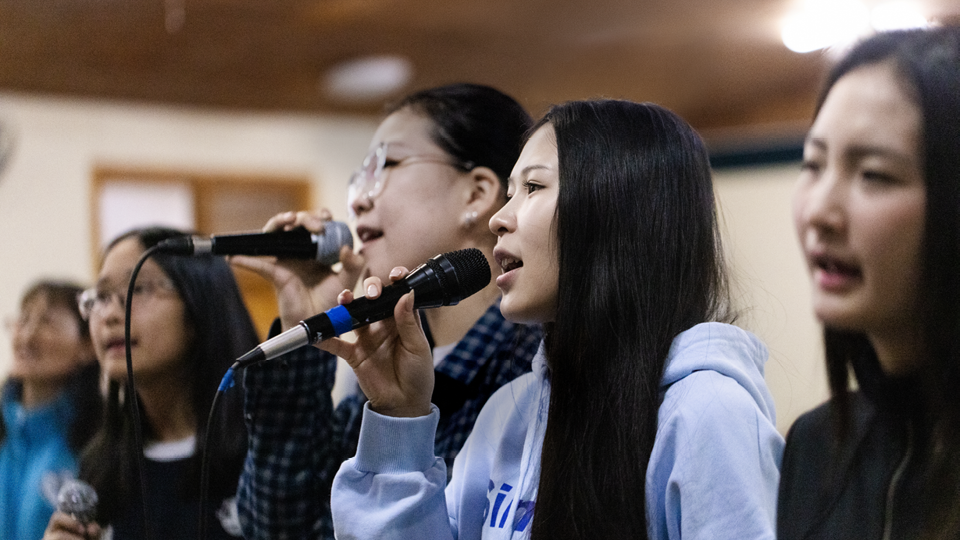
Ganaa spent a year going every Sunday to train the youth at that church until they were able to lead worship on their own. Seeing the fruit of Ganaa’s investment, other churches in the surrounding area started asking him to come and train their youth.
Every weekend, Ganaa loads up his car with a lot of instruments and a few teenagers from his church, and they travel to other churches to teach—sometimes driving several hours. But it isn’t just music that these young people are learning. They are being discipled, poured into, and seeing what it looks like to be a follower of Jesus. Ganaa teaches them that worshiping God isn’t just about playing an instrument, Tuya says.
Beloved Children of God
Years ago, when the Woods were first preparing to go to Mongolia, Cinda felt God speak to her about His heart for the Mongolian people. “I really felt God saying to me directly that the people of Mongolia were His beloved children—His beloved children that He’d never been able to embrace and hold,” she says, emotion in her voice. “Mongolians who haven’t accepted the good news, who haven’t accepted Jesus, are mostly searching for peace and haven’t been able to find it yet.”
Mark describes the issues of alcoholism in Mongolia, high rates of broken families, and the people’s need for hope. “That’s something that the peace of the good news and the presence of Jesus, His hope and light, speaks to,” he says.
Tuya and Ganaa also share from their own testimonies, the needs they had that only Jesus could meet. The youngest of six children, raised largely by her siblings, Tuya longed for love and identity. When she was 14, Tuya’s friend invited her to church for a Christmas service. In that service, she was able to feel the love of God her Father for the first time.
Ganaa searched for truth and answers—how does a person live a just and righteous life? “When the sun comes, it chases the darkness away,” Ganaa says. “When the gospel comes, hopelessness is chased away. When Jesus came into my life, I gained hope and eternal life. Life has a deeper purpose and a deeper meaning.”
“If you were to ask me, ‘What are you doing in Mongolia?’ my reply is that we’re planting oak trees,” Mark says. “What I mean by that is we are putting down roots of something that we want to see 100, 200, 300 years from now—a great harvest. When you look around the world, what The Christian and Missionary Alliance does is that we go into places that are dry and places that the soil is rocky, but we stay. And if it takes 300 years, we’re going to stick to it.”
Oak trees—the same image used by the prophet Isaiah as he describes what happens when broken hearts are comforted, freedom is proclaimed to captives, and those who mourn are filled with joy. “They will be called oaks of righteousness, a planting of the Lord for the display of his splendor” (Isa. 61:3c). Though the soil is rocky in Mongolia, oak trees are already growing.
From the very beginning of the Alliance movement, the missional focus has largely been on unreached peoples, the regions beyond, the neglected fields of the world. In many places, these least-reached people and areas lack any kind of gospel presence. International workers need to be sent to live in those places as witnesses to the good news of Jesus. But Mongolia is unique in this regard.
Even though the national church in Mongolia is relatively small, they are active, vibrant, and determined, positioned well to reach their own people with the gospel. Even beyond their own borders, Mongolians also have access to places that workers from other countries could never dream of entering. The sending potential of the Mongolian Alliance Church is significant. “Mongolians have the ability to go places that we can’t go,” Cinda says. “Not only can they go, they’re willing to go. And when they get there, they have the strength to endure and to stay and to really persevere in hard places, even above and beyond what we’re able to do. Mongolia has a unique role in seeing All of Jesus for All the World.”
Subscribe to Alliance Life Magazine
As an Alliance church member, you can join the 144-year legacy of Alliance Life and get exclusive stories and articles delivered directly to your mailbox or inbox. Click here to request your free subscription!